
Beyond the Chat: The Rise of AI Agents and Orchestrated Workflows
Discover how autonomous and multi-agent AI workflows are replacing simple prompts to solve complex engineering and business problems at scale.
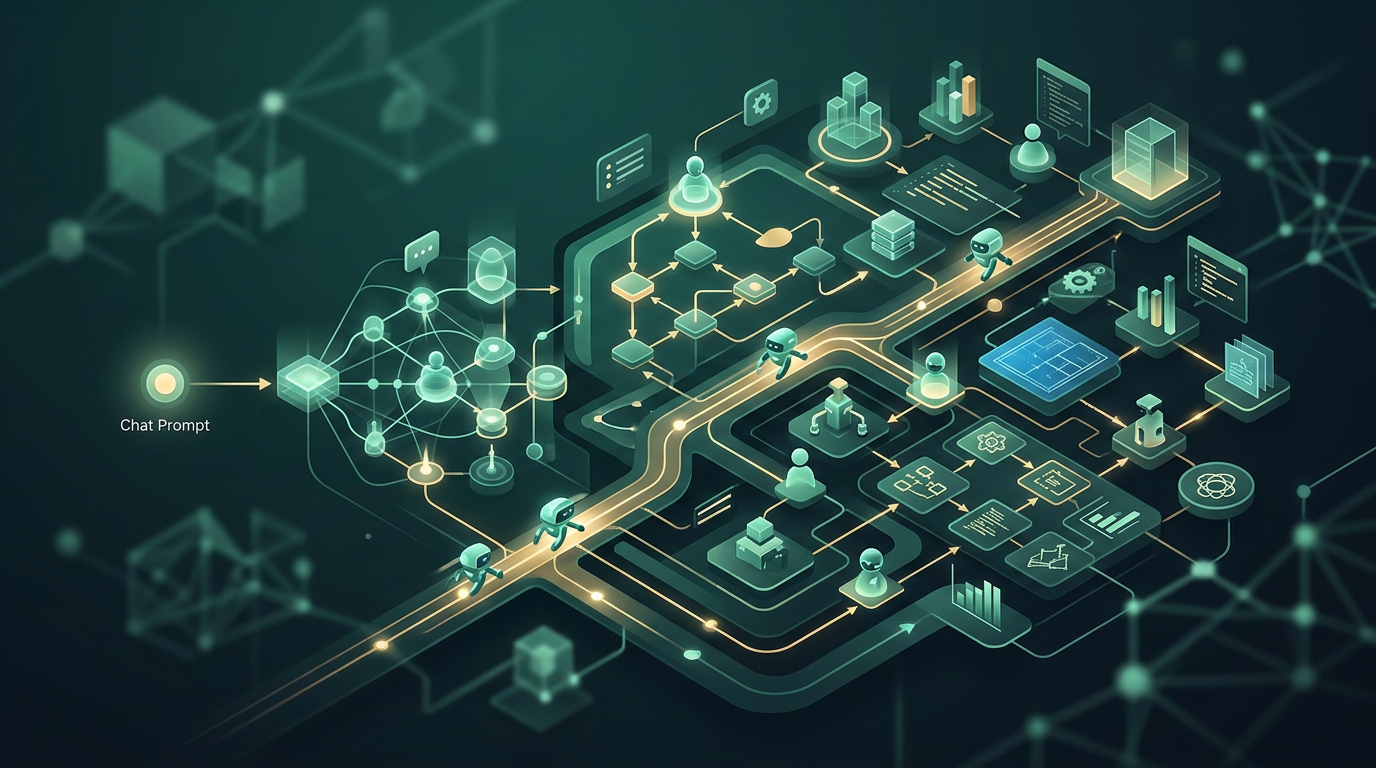
Writing a prompt in ChatGPT and getting a coherent answer feels like magic—until you try to use it to automate a 20-step accounting process or debug a 10-year-old Java monolith. The limit of current generative AI isn't the model itself, but the chat interface. The future isn't about talking to an AI; it's about building systems where multiple specialized agents talk to each other to execute real work.
From Prompt Engineering to Autonomous Agents
The paradigm is shifting. We are no longer looking for the "perfect prompt" that solves everything in a single turn. We are entering the era of Agentic Workflows. Instead of asking GPT-4 to "write a market report," we design a workflow where a Researcher Agent hunts for data, an Analyst Agent extracts trends, and an Editor Agent drafts the final result.
What defines a real agent?
An agent is more than just a wrapper for an LLM API. To be functional in a production environment, it requires four pillars:
- Perception: The ability to read files, databases, or browse the web.
- Memory: Both short-term (session context) and long-term (using vector databases like Pinecone or Weaviate).
- Tools: Access to calculators, Python code interpreters, or external APIs.
- Reasoning: The logic to decide which tool to use and when to stop.
"A single LLM is a brilliant speaker but a distracted worker. A multi-agent system is an assembly line with constant supervision."
Orchestration Architecture: The System's Brain
To build these systems, several frameworks have emerged that are defining the industry standard. If you are planning to implement AI in your company, these names should be on your radar:
- LangChain / LangGraph: Offers total granular control. LangGraph allows for cycles (loops), which is vital when an agent needs to self-correct.
- CrewAI: Focused on pragmatic collaboration. It defines roles, tasks, and processes (sequential or hierarchical) very intuitively.
- AutoGPT / BabyAGI: The pioneers, though today they are considered more as academic experiments than robust production tools.
Comparison: Sequential vs. Graph-Based Approach
Sequential flows are easy to debug: Step A leads to Step B. However, real-world problems are not linear. If Agent A makes a mistake, Step B will fail. Graph-based flows (like those in LangGraph) allow the system to go back, ask for clarification, or retry a task if validation fails. This resilience is what separates a toy from an enterprise tool.
Real Use Cases: Beyond Theory
What does this look like in practice? Let's consider technical support for a Fintech in LATAM. A traditional system uses a chatbot that spits out FAQs. An agentic workflow works like this:
- Triage Agent: Analyzes user tone and intent. If it detects fraud, it escalates to a human immediately.
- Query Agent: If it's a technical doubt, it accesses the transaction history via API with restricted permissions.
- Resolution Agent: Executes an action (e.g., unlocking a card) only if predefined business rules are met.
# Conceptual example of a tool definition for an agent
def get_user_balance(user_id: str):
    """Queries current balance in the banking core"""
    # Logic for secure database connection
    return balance_service.query(user_id)
Challenges: The Cost of Autonomy
It's not all sunshine and rainbows. Multi-agent systems introduce two critical problems: Latency and Cost. Each reasoning iteration is an API call that costs money and time. Optimizing this requires smaller, faster models (like Llama 3 or Claude Haiku) for simple tasks, reserving the "heavyweights" (GPT-4o) for final supervision.
How we approach it at Julsmind SAS
At Julsmind SAS, we don't implement generic chatbots. We design agent ecosystems that integrate with our clients' existing technology stacks. From Medellín to the world, we help companies transition from simple AI experiments to robust architectures that save thousands of man-hours. We understand that AI doesn't replace humans, but a human with a legion of AI agents does replace the competition that stuck with simple prompts.
The future of productivity isn't writing better instructions; it's building better systems. If you're ready to stop playing with chat and start deploying real autonomy, let's talk about orchestrating your own AI agents.