
From RAG to Agents: Why Your Static AI is Failing in Production
Discover why Agentic Workflows are replacing traditional RAG. A technical guide on AI orchestration, iterative reasoning, and real-world ROI for 2025.
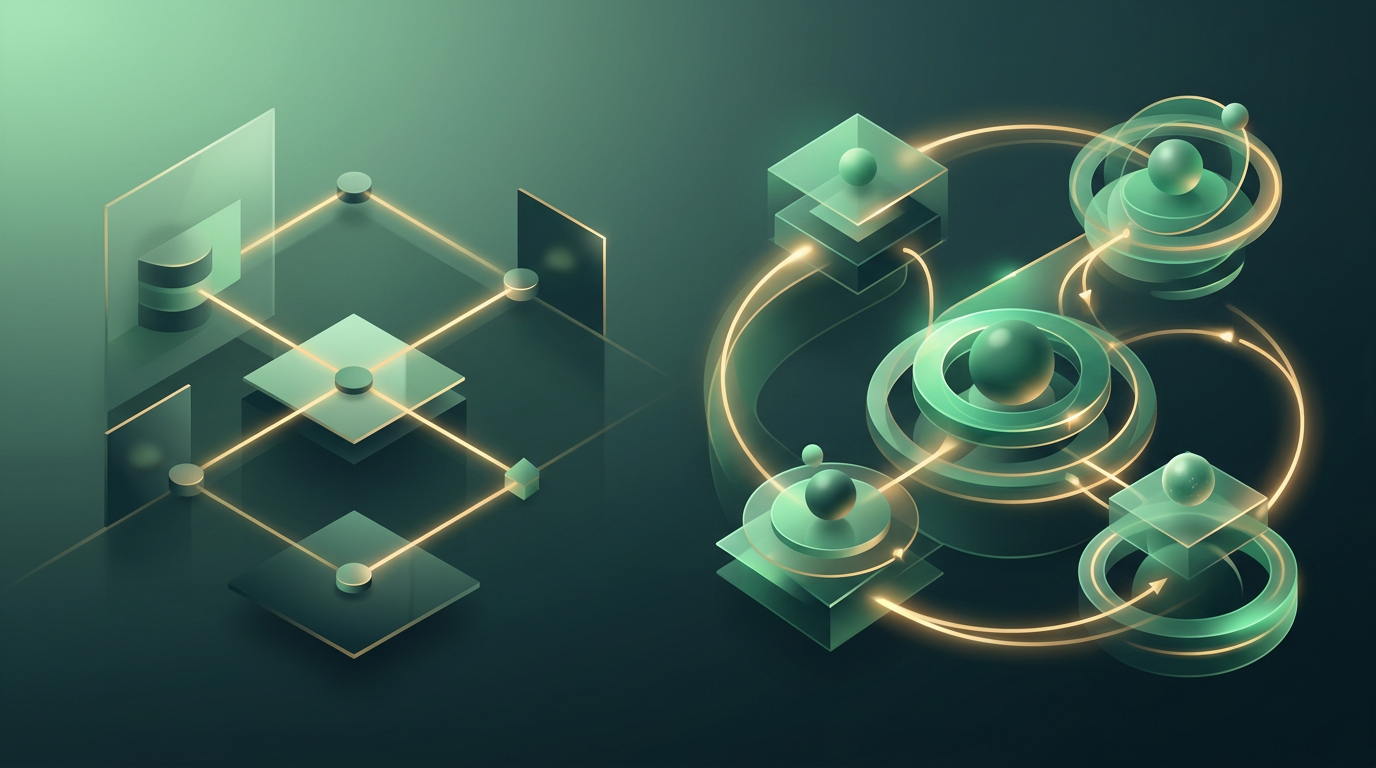
Eighty percent of Generative AI prototypes built on RAG (Retrieval-Augmented Generation) architectures never reach production because they fail at the last mile: the ability to reason through ambiguity. While traditional RAG is an efficient librarian that searches and summarizes, Agentic Workflows are executives who iterate, correct their own mistakes, and decide when they need more tools. In 2025, the question isn't whether you can connect your PDFs to an LLM, but whether that system can self-correct when a user's query is contradictory.
The Glass Ceiling of Traditional RAG
Standard RAG follows a linear path: the user asks a question, the system searches a vector database, retrieves chunks, and generates a response. It is useful but brittle. If the initial search fails or retrieves irrelevant info, the model hallucination occurs with high confidence. The problem isn't the LLM; it's the single-step architecture.
Why the 'Fire and Forget' approach fails:
- Lack of Verification: The system doesn't know if the generated answer actually answers the original prompt.
- Query Ambiguity: It cannot ask the user for clarifications if intent is unclear.
- Limited Context: It falls short when an answer requires joining data from multiple heterogeneous sources (SQL, CRM, and PDFs).
The Emergence of Agentic Workflows
Andrew Ng recently summarized it: the performance boost from GPT-3.5 to GPT-4 was significant, but the boost from zero-shot execution to an iterative agentic workflow is often greater than the generational jump of the base model itself. Agents aren't a single black box; they are a Plan -> Execute -> Reflect loop.
"An agent is not just a language model with tools; it is a software design pattern where the LLM acts as the reasoning engine within a control loop."
Critical Components of an Agentic System
- Short-term and Long-term Memory: The ability to remember previous interactions and execution states.
- Tools: APIs, web browsers, Python code executors, and database access.
- Planning: Breaking down complex tasks into manageable steps (Chain-of-Thought).
- Self-reflection: The agent reviews its own work for logical errors before delivery.
Comparison: RAG vs. Agentic Workflows
To understand ROI, we must look at accuracy in complex tasks. If your use case is "summarize this 50-page manual," RAG is enough. If your use case is "analyze discrepancies in the last 3 months of billing and propose a payment plan based on customer history," you need agents.
# Conceptual example of a reflection node in LangGraph
def self_reflect_node(state):
    answer = state['generation']
    score = judge_model.check_hallucination(answer)
    if score < 0.8:
        return "re_plan"  # Agent decides to re-plan the task
    return "end"
Practical Implementation: Tools and Frameworks
Don't reinvent the wheel. The ecosystem has matured rapidly to support these iterative cycles:
- LangGraph: For building cyclic graphs with fine-grained control.
- CrewAI: Excellent for orchestrating multiple agents with specific roles.
- AutoGen: Microsoft's framework for multi-agent conversations.
- PydanticAI: To ensure data entering and leaving agents is strictly typed and validatable.
How we approach it at Julsmind SAS
At Julsmind SAS, based in Medellín and serving a global market, we've seen that the biggest barrier to AI isn't technology—it's data trust. We don't just build chatbots; we design reasoning systems. We use agentic architectures for financial auditing, advanced technical support, and sales ops automation, ensuring every response passes through human-in-the-loop and synthetic validation layers. Our nearshore advantage allows us to iterate rapidly in your time zone with senior talent who understands the full MLOps lifecycle.
The transition from static systems to dynamic agents is the logical next step for any enterprise seeking a real return on AI investment. If you are tired of hallucinating prototypes and want to build a data infrastructure that actually acts, let’s talk. Reach out today for a strategic session on your AI roadmap.