Why the MVP is Dead: Adopt the RAT for Serious Products
Discover why the Minimum Viable Product (MVP) is no longer enough in saturated markets and how the RAT approach reduces actual business risks.
Shipping a mediocre app under the excuse that it is an 'MVP' is the fastest way to burn capital and reputation in today's market. For a decade, the Minimum Viable Product was the sacred mantra of Silicon Valley, but its interpretation became warped: we moved from 'validating fast' to 'shipping unfinished garbage.' Today, in an ecosystem saturated with SaaS solutions and mobile apps, users do not forgive a lack of polish. The MVP is dead because it is no longer enough to capture attention or validate if a business is truly viable.
The Systemic Problem of the MVP: Building Bias
The biggest flaw of the MVP is semantic and psychological. The word 'Product' prompts teams to build code before understanding the problem. Founders and product managers become obsessed with feature backlogs instead of obsessing over business model risks. This creates the 'Sunk Cost Fallacy': once you've spent three months and $50,000 USD developing that 'minimum,' it becomes emotionally impossible to pivot, even if the data says no one cares.
The Technical Feasibility Trap
Many teams confuse viability with 'can we build it?'. In 2024, almost anything can be built with enough time and budget. The real question is not technical, but existential: 'will anyone pay for this?' or 'can we acquire users for less than they are worth?'. The MVP often skips these questions to focus on development sprints.
Enter the RAT: Riskiest Assumption Test
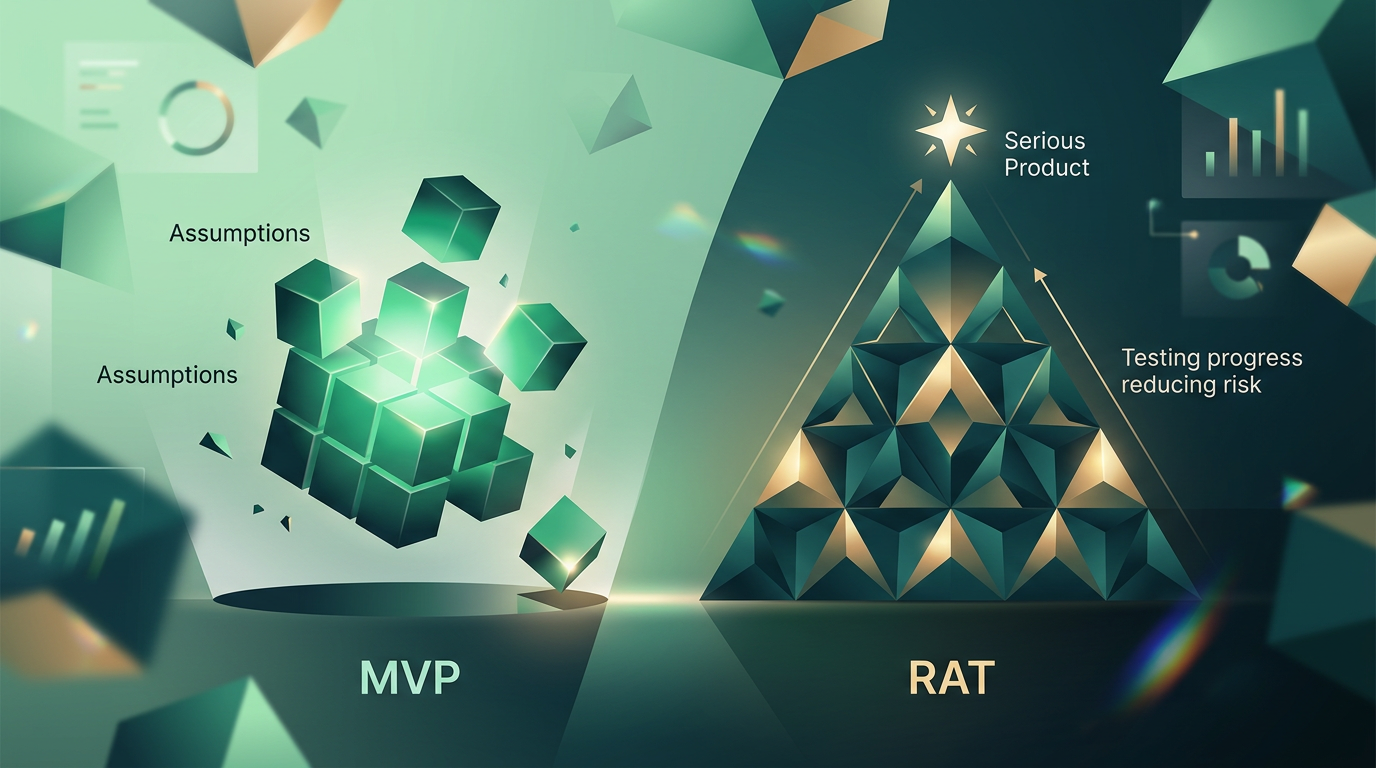
If you want to build software that survives, you must bury the MVP and adopt the Riskiest Assumption Test (RAT). Unlike the MVP, the RAT is not about building a functional prototype; it's about identifying the assumptions that, if false, would cause the entire project to collapse. The goal isn't to create a product, but to gain validated learning with the least effort possible.
- MVP focus: What is the minimum we can build?
- RAT focus: What is the most important thing we need to learn?
"The success of a startup or a new product is not measured by how many lines of code are delivered, but by the speed at which the team moves through the learning cycle about what to build."
How to Apply the RAT Framework to Your Next Iteration
To implement an effective RAT, you must break down your business idea into three fundamental assumption pillars. Do not move to code until all three have real, non-hypothetical evidence:
- Desirability: Do users actually have this problem? Is it painful enough to seek a solution?
- Viability: Can we capture economic value? Is the market large enough?
- Feasibility: Are there insurmountable legal, technical, or infrastructural constraints?
Tools to Validate Without Writing a Single Line of Code
Before hiring a full-stack engineering team, use low-fidelity methods that extract honest market signals:
- Fake Door Testing: A landing page with a 'Pricing' button that captures emails. If the CTR is low, the problem isn't your software; it's your value proposition.
- Concierge Testing: Perform the service manually behind a simple interface. If you can't sell it manually, automating it won't help.
- Problem Interviews (The Mom Test): Talk to potential customers without mentioning your idea, looking for evidence of past behaviors.
From Learning to the Minimum Sellable Product (MSP)
Once the RAT has validated that an opportunity exists, do not go back to a mediocre MVP. Evolve toward the Minimum Sellable Product (MSP). The difference is aesthetic and functional: an MSP must delight. It doesn't need 50 features, but the two it has must work better than anything else on the market. In the age of AI and high-fidelity design, 'user experience' is not a luxury—it's the price of entry.
Comparison: Which stage are you in?
Phase 1: RAT -> Crucial Hypothesis Validation (Low Cost)Phase 2: MSP -> Production-Quality Product (Focus on UX)Phase 3: Scale -> Optimization and New FeaturesHow we approach it at Julsmind SAS
At Julsmind SAS, we refuse to be just a 'software factory' that churns out code by the hour. We act as strategic partners. Before proposing a cloud architecture or complex AI integration, we challenge our clients' assumptions. We use product discovery methodologies to ensure that what we build in Medellín for the world not only works technically but also makes business sense. We help define critical RATs so that our clients' investment is protected by data, not hunches.
Do you have an innovative idea but aren't sure where to start validating without spending a fortune? Let's talk about transforming your doubts into certainties before writing the first line of code. Reach out to us here for a strategy session.