
From Chatbots to Autonomous Teams: The Rise of AI Agentic Workflows
Explore how AI agentic workflows are replacing simple prompting. A technical guide on AutoGen, CrewAI, and enterprise orchestration strategies.
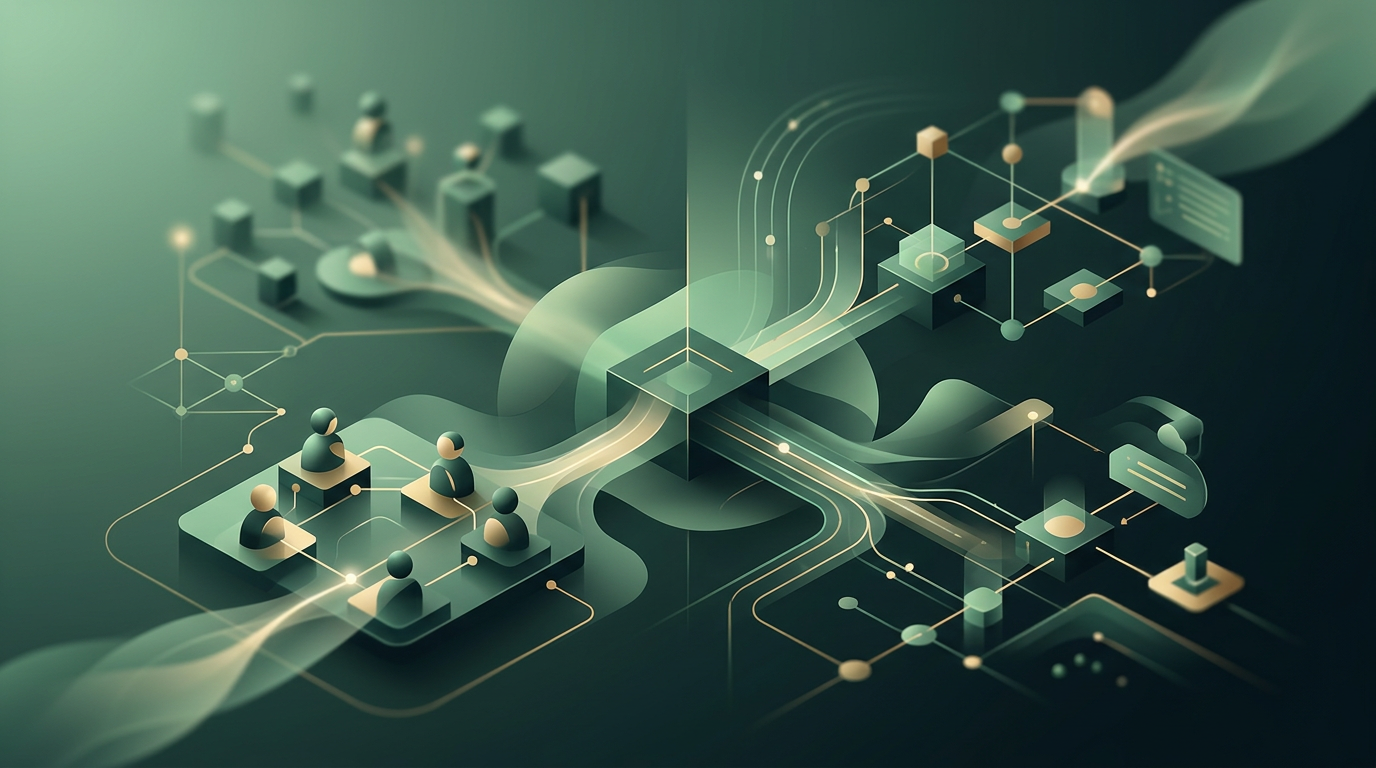
Writing a perfect prompt has become the digital equivalent of trying to start a fire by rubbing sticks together: it is frustrating, inefficient, and rarely produces consistent results at scale. While most companies remain trapped in the 'Chatbot as Interface' paradigm, the technological frontier has shifted toward Agentic Workflows. Here, it is no longer about asking GPT-4 to write an email; it is about orchestrating a chain of autonomous agents that plan, research, execute code, and self-correct without human intervention.
Why simple prompts are no longer enough
The inherent problem with Large Language Models (LLMs) is their transactional nature. In a standard interaction, the user is solely responsible for the workflow logic. If the model hallucinates or makes a calculation error, the process stops or fails silently. Agent-based architecture changes this by introducing feedback loops.
- Iterative Reasoning: The agent doesn't just respond; it generates a plan, executes it, and evaluates the outcome.
- Tool Use: Agents can interact with external APIs, SQL databases, and Python terminals to validate data in real-time.
- Specialization: Instead of a single generalist model, we use multiple agents with defined roles (a Researcher, a Coder, a Reviewer).
"The future of AI is not a smarter chatbot, but a system capable of reasoning systematically through multiple execution steps."
The anatomy of an agentic workflow
To implement these systems in production environments, especially for clients seeking scalability from LATAM to the global stage, we use orchestration architectures. We are not just tossing words into a box; we are building software that uses AI as its engine. A typical flow includes:
1. The Orchestrator (Manager)
This is the brain that receives the main mission. It decomposes an ambiguous goal—such as "perform a sentiment analysis of the last 500 brand mentions on Twitter and generate a comparative report"—into granular tasks.
2. Memory and Context
Unlike an ephemeral chat session, modern agents utilize vector databases (like Pinecone or Weaviate) to maintain long-term memory and access internal business documents via RAG (Retrieval-Augmented Generation).
Tools defining the market
At Julsmind, we constantly evaluate the ecosystem to determine which tools offer the greatest enterprise stability. Currently, three names dominate the conversation:
- LangGraph: Ideal for cyclic workflows where precise control over state and decision logic is required.
- CrewAI: Excellent for orchestrating teams of agents that must collaborate following predefined processes (sequential, hierarchical, or consensual).
- Microsoft AutoGen: A powerful platform for multi-layered agent conversations, allowing AI to 'self-repair' by debugging its own code.
Real-world use cases: Beyond toy examples
What does this look like in real life? Imagine a development team in Medellín working for a Fintech in London. Instead of a human spending 4 hours reviewing error logs, a swarm of agents can:
- Monitoring Agent: Detects the server anomaly.
- Diagnostic Agent: Extracts relevant logs and searches for known patterns in internal documentation.
- Patching Agent: Writes a code fix proposal and tests it in an isolated sandbox environment.
- Supervisor Agent: Sends an executive summary to the human team with the suggested solution and expected impact.
Technical challenges: The cost of autonomy
It is not all magic. Agentic flows introduce complex variables that any CTO must consider. First, latency; each agent's reasoning cycle adds seconds of wait time. Second, cost; multiple calls to GPT-4o or Claude 3.5 Sonnet can inflate bills if token budgets are not implemented. Finally, observability; debugging a system where one agent made a decision based on another agent's flawed output requires advanced tools like LangSmith.
How we approach it at Julsmind SAS
At Julsmind SAS, we don't build simple OpenAI wrappers. We design agentic ecosystems that integrate with our clients' existing infrastructure. From our hub in Medellín, we apply fine-tuning techniques and advanced RAG architectures to ensure agents understand the specific context of each industry, minimizing hallucinations and ensuring data security. We believe competitive advantage lies not in having the latest model, but in how you orchestrate your data with the power of agents.
The transition from passive systems to active agents has already begun. If you are ready to transform your operational processes into autonomous execution engines, we are ready to help you design the right architecture. Let’s discuss the future of your product on our contact page.