
Event-Driven Architecture: Kafka or RabbitMQ for Scaling?
Technical guide on Event-Driven Architectures (EDA). Real-world comparison between Kafka and RabbitMQ, implementation patterns, and microservices code snippets.
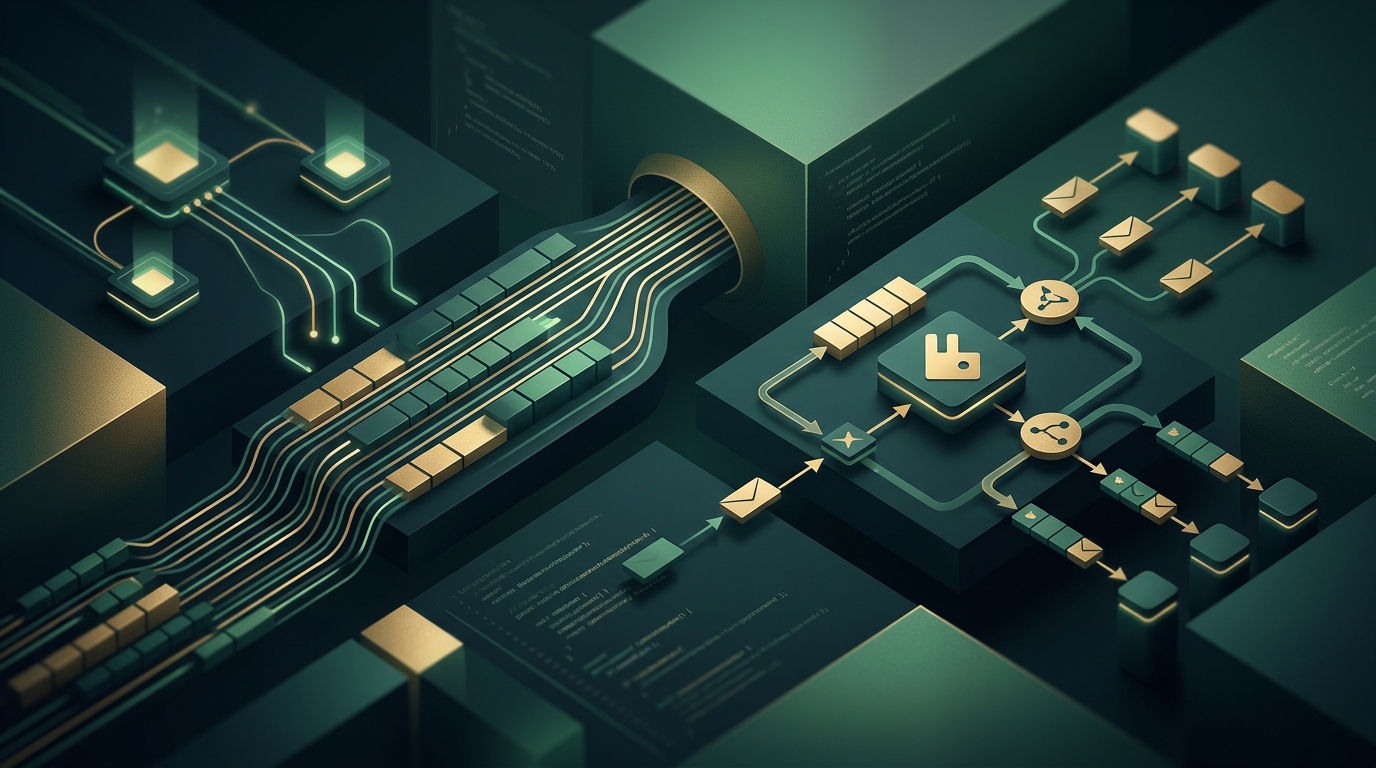
Launching a distributed system and expecting synchronous HTTP requests to keep their sanity is the technical equivalent of playing telephone with a megaphone: eventually, someone goes deaf or the message gets lost. Event-Driven Architecture (EDA) isn't a fad; it's the response to the fragility of coupled systems that die when a single service takes 200ms longer than expected.
The End of Temporal Coupling
In a traditional architecture, if Service A needs Service B to process something, it waits for a response. If B is down, A fails. EDA breaks this chain. Services don't call each other; they emit facts (events) about what has happened. An event is an immutable notification that something occurred in the past: OrderPlaced, PaymentValidated, InventoryDepleted.
The advantage isn't just technical; it's business-oriented. It allows multiple consumers to react to the same event without the producer even knowing they exist. This 'publish and forget' topology is what allows companies like Uber or Netflix to handle millions of transactions per second without collapsing under the weight of network latencies.
Kafka vs. RabbitMQ: They Aren't the Same, and Never Were
It's common to hear both described as "message queues," but they operate under radically different philosophies. Choosing the wrong one here can cost you months of refactoring.
RabbitMQ: The Smart Postman
RabbitMQ is a traditional message broker. It ensures the message gets from point A to point B. Once a consumer confirms they've read the message (ACK), it disappears from the queue. It's ideal for transactional tasks where exact ordering and guaranteed delivery are critical, but we don't need to re-read the past.
Apache Kafka: The Immutable Diary
Kafka is a distributed event log. It doesn't delete messages upon reading; it stores them on disk for a set retention period. This allows a new service to connect today and read everything that happened three days ago to reconstruct its state. It is, essentially, a database optimized for massive sequential writes.
"Use RabbitMQ if you need complex routing and priority logic. Use Kafka if you need to process real-time data streams and bulletproof persistence."
- RabbitMQ: Push-based. The broker pushes messages to consumers.
- Kafka: Pull-based. Consumers request data from the broker at their own pace.
- Scalability: Kafka scales horizontally natively via partitions; RabbitMQ requires more delicate cluster configurations for massive volumes.
Real-World Implementation Patterns
Implementing EDA isn't just about installing a broker. It requires specific patterns to avoid data chaos:
- Outbox Pattern: Prevents desynchronization between your database and the broker. You write the event to an 'Outbox' table within the same transaction as your business data, and a separate process publishes it.
- Event Sourcing: Instead of storing only the current state (e.g., balance = 100), you store all events that led to that state (+50, +70, -20).
- CQRS (Command Query Responsibility Segregation): Separates writes (Commands) from reads (Queries), using events to keep the read view updated.
Code Example: Producer in Node.js using KafkaJS
const { Kafka } = require('kafkajs');

const kafka = new Kafka({
  clientId: 'order-service',
  brokers: ['localhost:9092']
});

const producer = kafka.producer();

const run = async () => {
  await producer.connect();
  await producer.send({
    topic: 'orders',
    messages: [
      { value: JSON.stringify({ id: '123', status: 'created', user: 'juls_user' }) },
    ],
  });
};

run().catch(console.error);
Error Handling Strategies: Dead Letter Queues (DLQ)
What happens when an event fails? You can't just stop the flow. This is where DLQs come in. If a consumer cannot process a message after N retries, the message moves to a "dead letter" queue for manual inspection or scheduled retry. This prevents queue poisoning, where a single malformed message stops the entire company's processing.
How we approach it at Julsmind SAS
At Julsmind SAS, we've designed event architectures for clients in the US and LATAM handling unpredictable traffic spikes. We don't apply a one-size-fits-all solution; we analyze whether your use case requires RabbitMQ's low latency or the massive throughput of Kafka on AWS MSK or Confluent. Our approach from Medellín is to build resilient systems that don't just work today but allow adding new features tomorrow without touching a single line of core transactional code.
If your current architecture feels like a house of cards about to fall due to a network glitch, let's talk. We can help you migrate to an event-driven ecosystem that scales with your business. Tell us about your challenge on our contact page.