
Hybrid Automation: The End of Rigid Integrations in 2024
Learn how to combine no-code tools with robust backend orchestration to scale internal processes without compromising security or technical flexibility.
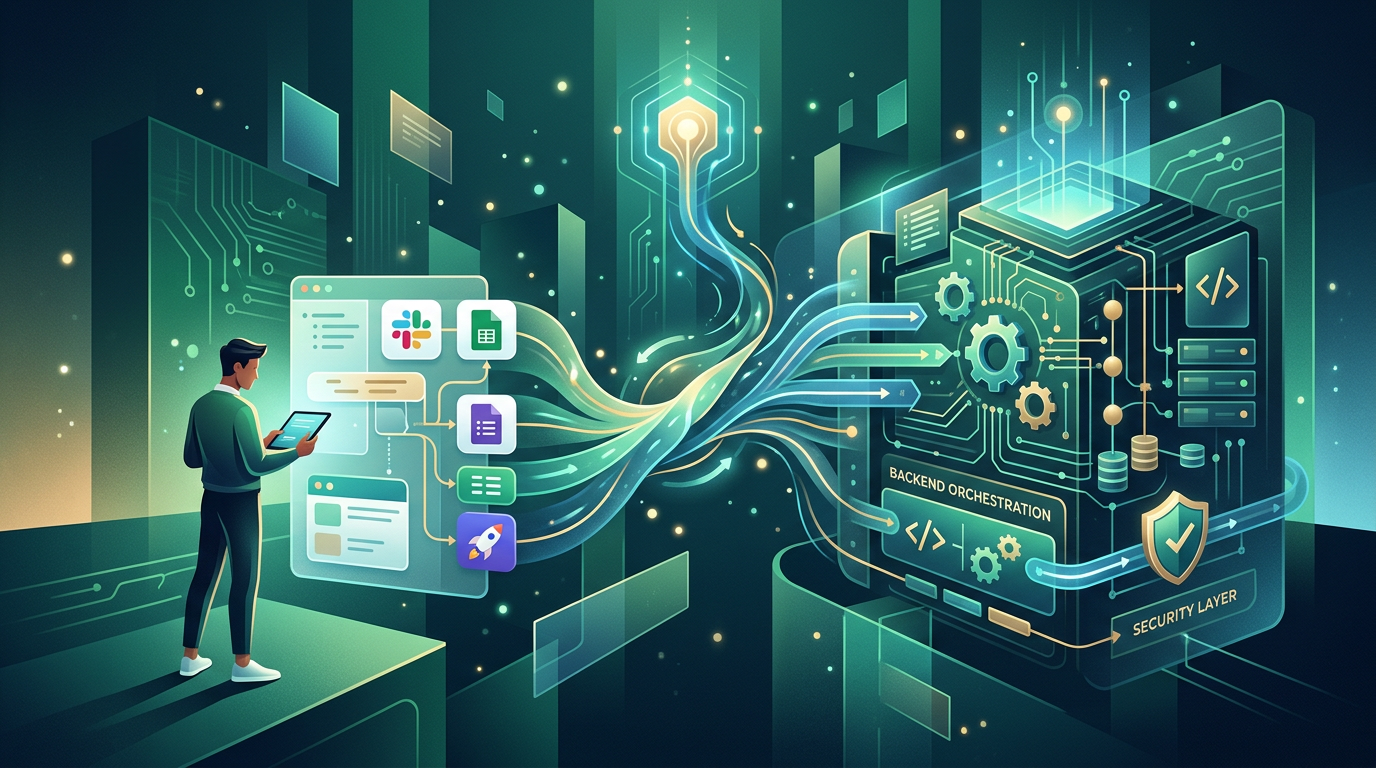
Most companies are trapped in a false dichotomy: they either build custom software from scratch, taking months, or patch critical processes with a fragile web of no-code connectors that break at the first API change. The real leap in productivity isn't in choosing a side, but in hybrid automation—where low-code agility meets professional backend governance.
The Problem with 'Zapier-Dependency' at Scale
Zapier and Make are fantastic tools for prototyping, but relying on them for mission-critical processes is playing Russian roulette with latency and costs. When your workflow processes 50,000 leads a month, a $500 USD bill just for automation tasks starts to hurt, especially when you lack full control over error handling or retrying failed steps.
Common Limitations of Pure No-Code
- Data Opacity: It's hard to audit exactly what happened at step 4 of 10 when something fails silently.
- Exponential Costs: The pay-per-task model penalizes volume growth.
- Security: Managing sensitive API keys on third-party platforms always carries a higher residual risk than a self-hosted solution.
Modern Orchestration: The Rise of n8n and Temporal
This is where modern orchestration comes in. Tools like n8n allow for a "code exactly when you need it" approach. You can drag nodes to connect Slack with Salesforce, but you can also write a JavaScript snippet directly in the flow to transform complex data without creating a dedicated microservice.
"Successful automation isn't about eliminating the programmer; it's about allowing the programmer to focus on business logic while visual tools handle the connectivity."
For high-fidelity use cases where a flow cannot fail under any circumstances (like a financial transaction or infrastructure provisioning), Temporal.io is redefining what resilience means. Unlike visual tools, Temporal allows you to write workflows as pure code that are inherently durable and recoverable.
Comparison: When to Use Which?
Not every task requires the same heavy artillery. Here is a quick guide:
- Marketing Ops and CRMs: No-code tools (Make, Zapier). Iteration speed takes precedence over extreme robustness.
- Data Processing and Light ETLs: n8n (Self-hosted). You control the data, costs are fixed, and you can inject complex logic.
- Core Transactional Systems: Custom development + State orchestrators (Temporal). Where every step must be traceable and atomic.
Implementing a Smart 'Glue Code' Layer
The most common mistake is trying to make the orchestrator do everything. The best practice is to expose core backend functionalities through Webhooks or private APIs and use the automation tool only for flow logic.
// Example of a secure webhook receiving data from a no-code flow
app.post('/api/v1/internal/sync', async (req, res) => {
  const { leadId, source } = req.body;
  // Validate security signature
  if (!isValidSignature(req.headers)) return res.status(401).send();

  // Execute heavy business logic in the backend
  await processLeadEngagement(leadId);

  res.status(200).json({ status: 'queued' });
});
Modern RPA Strategy: Beyond Clicks
Traditional RPA (Robotic Process Automation) is dying to make way for intelligent agents. We no longer record clicks on a screen; we use Large Language Models (LLMs) to interpret interfaces or extract data from unstructured documents. If your process requires reading a PDF and then updating a legacy accounting system without an API, an AI agent integrated into your n8n flow is 10 times more efficient than an old-school UIPath bot.
Steps for a Successful Transition
- Shadow IT Audit: Identify which flows are currently running on personal Zapier accounts.
- Centralization: Move critical processes to your own n8n instance or an enterprise platform.
- Hybridization: Create micro-services for heavy logic and use the visual interface only for routing.
How we approach it at Julsmind SAS
At Julsmind SAS, we don't believe in one-size-fits-all solutions. We help companies in Medellín and global markets design automation ecosystems that scale. From implementing self-hosted n8n instances to reduce operational costs, to building custom microservices that act as anchors for no-code flows, we build bridges between business agility and technical robustness. Our approach ensures your operations team remains autonomous without creating a maintenance nightmare for your engineering team.
Does your automation infrastructure feel like a Jenga tower about to fall? Let's discuss how to professionalize your internal flows and reduce operational costs at our contact page.