
Logistics 4.0: How LATAM Retail is Winning the Last Mile
Technical analysis on how retail in Colombia, Brazil, and Mexico optimizes last-mile logistics with AI, advanced geocoding, and real-time orchestration.
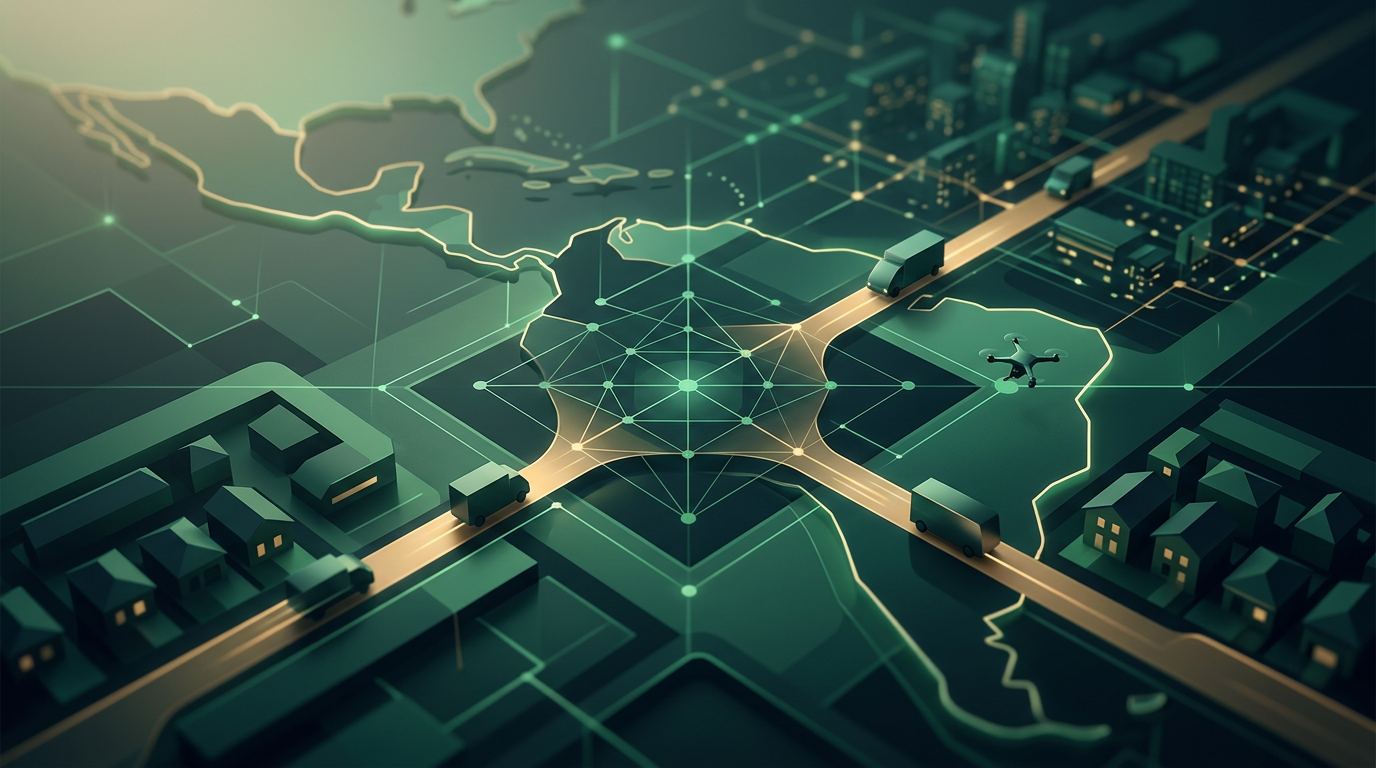
The Tyranny of 'Delivered Today' in LATAM Geography
Delivering a package in Medellín is not the same as delivering it in Chicago. In Latin America, retail doesn't just fight chaotic traffic and ambiguous addresses; it fights a fragmented infrastructure that eats profit margins. However, giants like Mercado Libre, Rappi, and Frubana have proven that competitive advantage no longer lies solely in inventory, but in the algorithmic ability to predict where the next order will be before the customer even clicks.
The Billion-Peso Problem: Why Does the Last Mile Fail?
The last mile accounts for up to 41% of total supply chain costs. In countries like Mexico and Colombia, this cost skyrockets due to three critical factors: lack of standardized address nomenclature, urban traffic volatility, and the operational cost of delivery retries. A returned package isn't just a transport cost; it's a loss of customer trust that is rarely regained.
The Nightmare of Imprecise Geocoding
Most standard Google Maps or Mapbox systems struggle in the outskirts of Latin American cities. This is where Custom Geocoding comes in. Leading companies are using proprietary data layers (local POIs) and Machine Learning models to correct addresses in real-time, reducing location errors from a 200-meter radius to less than 10 meters.
Real Cases: From Intuition to Prediction
Let's analyze how the pieces are moving on the regional board:
- Brazil and Micro-Logistics: Large retailers are turning their physical stores into urban 'Dark Stores'. Orchestration software decides in milliseconds whether an order ships from a regional DC or the store three blocks away from the user.
- Colombia and Agile Cross-Docking: Logistics startups are implementing dynamic 'Clustering' algorithms. Instead of fixed routes, the system groups orders by traffic density and changing delivery windows, allowing a courier to complete 25% more deliveries per shift.
- Mexico and Fraud Prevention: Integrating AI to validate Proof of Delivery (POD) via image recognition and biometrics is reducing 'package not received' disputes by 15%.
"Logistics in LATAM stopped being a truck problem and became a data problem. Whoever processes telemetry best will dominate the market."
Tech Stack: The Engine Under the Hood
To build a scalable last-mile solution in 2025, a mobile app isn't enough. A robust microservices architecture is required:
- Route Optimization Engine (VRP): Implementations using libraries like Google's OR-Tools or custom Python solutions that solve the Vehicle Routing Problem considering cargo, time, and fuel constraints.
- Event-Driven Architecture: Using Kafka or RabbitMQ to process thousands of GPS coordinates per second without crashing the relational database.
- Graph Databases: Such as Neo4j, ideal for understanding complex relationships between distribution nodes and delivery points.
// Simplified dynamic assignment logic
if (courier.capacity > order.volume && route.distance_to(order) < threshold) {
  assign_order_to_route(order, route);
  recalculate_eta(route);
}
The Human Impact and Talent Nearshoring
It’s not just about robots. Technology must empower the driver. User interfaces (UI) for couriers in LATAM must be designed for low connectivity and high readability under the sun. Developing these tools requires deep knowledge of the local context. This is where talent in hubs like Medellín is making a difference, combining technical excellence with empathy for the region's operational challenges.
How we approach it at Julsmind SAS
At Julsmind SAS, we understand that retail in LATAM doesn't need generic Silicon Valley solutions, but custom engineering that understands the potholes and local culture. We have helped companies integrate AI engines for demand prediction and route optimization, reducing operational costs by up to 22%. Our development approach in Medellín allows us to iterate fast, speaking the same language as your operations and end-users, ensuring that software is an asset, not a bottleneck.
Is your logistics operation losing money at every traffic light or misspelled address? Let's talk about how AI can transform your last mile. Reach out to us at our contact page and let's design a solution that moves your business forward.